Periodontitis is destructive disease of periodontium that leads to loss of teeth. Periodontitis may result from poor oral health and which is further aggravated by systemic diseases. Periodontitis can be localized to few teeth and sometimes generalized involves all teeth in the oral cavity. Patients affected with periodontitis will complains food lodgment between teeth due to pocket formation, bleeding and pus formation in the gums, mobile teeth. This can occur in young age groups to elderly people.
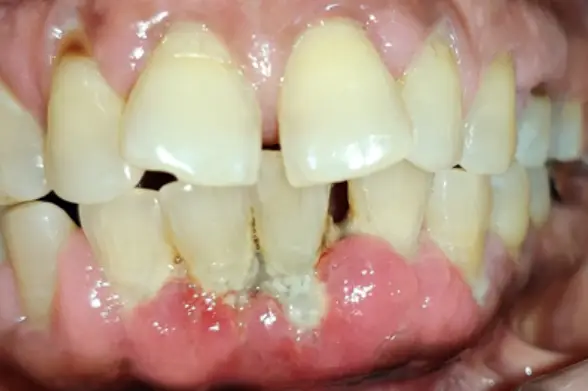
Clinical presentation:
A patient of age 58 years visited my dental clinic with complaint of swollen gums and mobile teeth. She also reported that bleeding and pus formation in upper and lower front teeth gums. Patient medical history reveals that she hypertensive and under medication with amlodipine. She is laso diabetic and under medication. Clinical examination presented a soft gingival overgrowth all over the teeth especially plaque retained areas. Radiographic examination showed bone loss over all the teeth.
Clinical interpretation
The gingival overgrowth was due to amlodipine medication used for hypertension treatment. This condition further aggravated by diabetes and poor oral hygiene leading to severe periodontal infection and mobility of teeth.
Diagnosis:
The case was diagnosed as chronic generalized periodontitis with drug induced gingival enlargement.
Treatment:
The gingival overgrowth conditioned was communicated with patient cardiologist and explained the concern with amlodipine medication and requested to change to alternative medication for hypertension. Patient was kept under antibiotic for 7 days. Preliminary oral prophylaxis was done for the patient to remove the localized calculus and mouth washes are advised. After one-week, acute infection was subsided. Open flap surgery was done after 7 days in two appointments. During surgical procedure gingivectomy was performed to remove the excess fibrous growth of gingiva. All mobile lower anterior teeth were extracted. After a month, rehabilitation of lower anterior teeth was done with fixed partial denture.
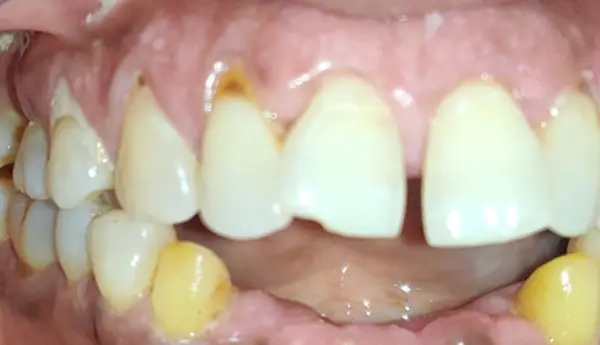
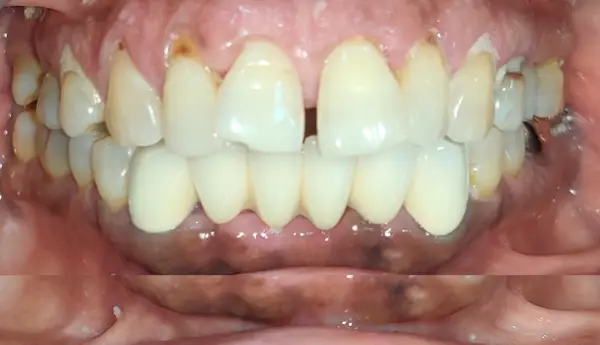
Takeaway points:
Oral medication used in the treatment of hypertensive drugs and anticonvulsant drugs used for seizures are known to cause gingival enlargement. Patients using this medication should regularly visit dentist for good oral health. If similar condition was occurred, first medication should be changed and later treatment of existing condition should be done for better results.
Gum Enlargement: Patient Questions
What does gum enlargement actually feel like?
Most people notice it visually before it becomes uncomfortable — gums that look puffy, rounded and shiny, sometimes creeping over the teeth so they appear shorter. It often bleeds when brushing. Pain is not usually the first symptom, which is why it tends to be well established before people seek help.
Can medication cause it?
Yes, and this is frequently missed. Three drug groups are well documented: certain anti-epileptics (notably phenytoin), some calcium channel blockers used for blood pressure (such as nifedipine and amlodipine), and immunosuppressants like ciclosporin. If you take any of these, mention it at your appointment — it changes both the diagnosis and the plan. We never advise stopping a prescribed medicine; the approach is to control the plaque that triggers the overgrowth, and coordinate with your physician where a change is worth considering.
Will it go away on its own?
Mild inflammatory enlargement often improves substantially once the plaque and tartar driving it are removed with professional scaling and home care improves. Longer-standing enlargement, particularly the fibrous kind associated with medication, does not resolve by itself and may need surgical reshaping (gingivectomy) — which can be done with a soft-tissue laser in suitable cases.
Does it come back after treatment?
It can, and honesty matters here. Where the underlying cause remains — ongoing medication, or plaque control that slips — recurrence is common. This is why the maintenance phase is not optional. Patients who keep to their periodontal review schedule have far better long-term outcomes than those who treat the surgery as the finish line.
Is gum overgrowth ever serious?
Most cases are inflammatory or drug-related and not dangerous in themselves, though they do make cleaning harder and accelerate gum disease. However, any localised, firm or rapidly growing swelling that does not respond to plaque control needs proper diagnosis rather than assumption — occasionally these are other lesions entirely. That is a reason to be seen, not a reason to panic.

Written and medically reviewed by
Dr. Chakradhar
MDS — Periodontics | Implantologist
Periodontist at Ravi's Dental Care & Implant Centre, MVP Colony, Visakhapatnam, treating gum disease, recession and the oral-systemic links that affect medically compromised patients.