The short answer
Neither a dental bridge nor a dental implant is better for everyone. An implant usually suits you when the teeth beside the gap are healthy and your bone, gums and general health allow minor surgery. A bridge usually suits you when the neighbouring teeth already need crowns, or when you want to avoid surgery and finish sooner. Long-term studies show similar 10-year survival for both, so the right choice depends on your teeth, gums, bone, budget and timeline.
If you have one missing tooth, either an implant or a bridge can help you chew and smile comfortably again. The dental bridge vs implant decision should consider the whole replacement: what supports it, which teeth need treatment, how long it takes to complete, what it costs in total and what future care involves.
This guide explains the main differences between an implant and a bridge, which one lasts longer, which is more painful, how costs compare in Vizag, and what to ask your dentist before deciding.
Dental Implant vs Bridge: The Main Differences
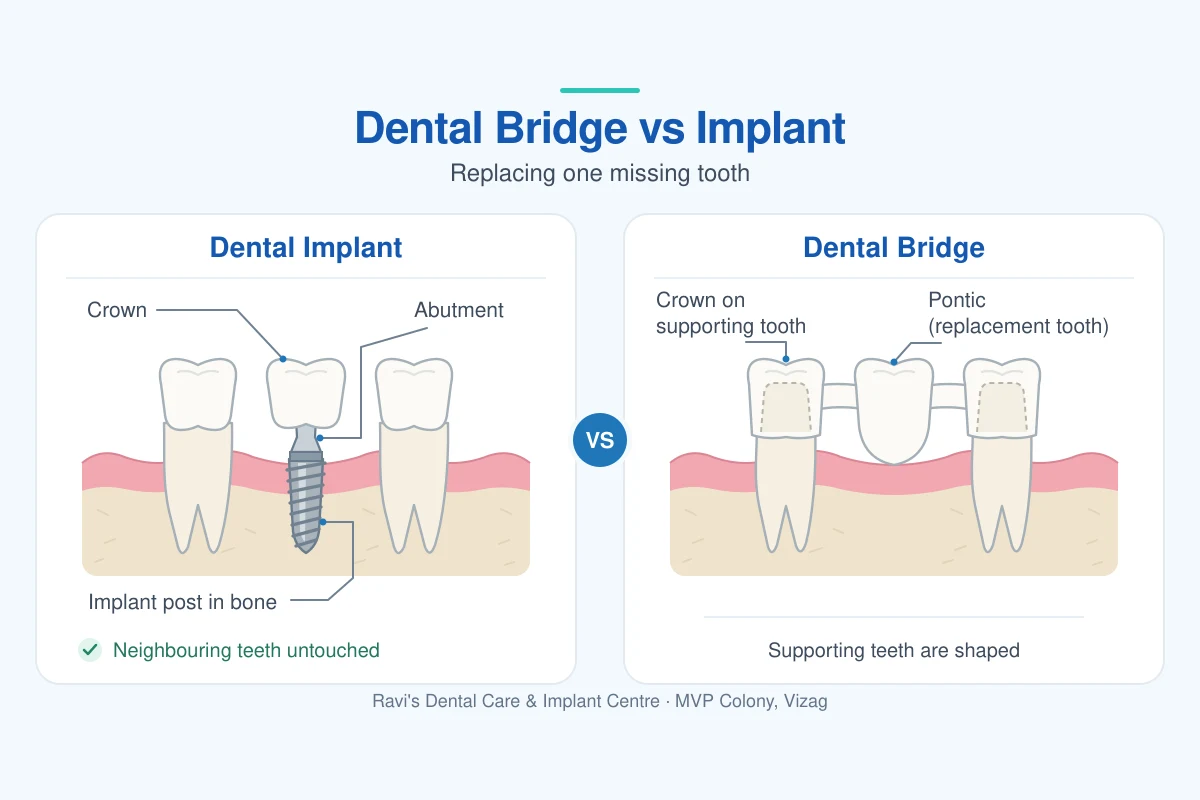
An implant is a small post, usually made of biocompatible titanium, placed in the jawbone. It acts as an artificial root. A connector (abutment) joins the post to a crown, which is the tooth-shaped part you see above the gum.
A bridge fills the gap by taking support from the nearby teeth. In a conventional bridge, the teeth on either side are shaped to hold caps (crowns). A replacement tooth, called a pontic, sits between those caps.
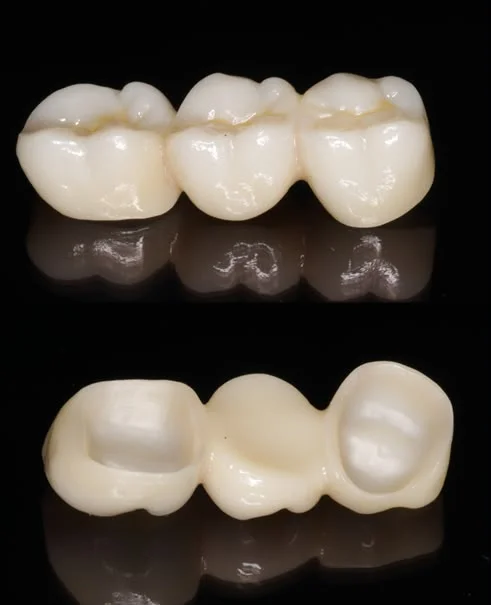
The three parts are joined together, forming a three-unit bridge that replaces one missing tooth. The photo shows one from above (top) and from underneath (bottom): the two hollow caps slide over the shaped supporting teeth, and the solid pontic in the middle rests on the gum. Other designs, such as a bonded (Maryland) bridge, are also available.
| What matters to you? | Dental implant | Conventional bridge |
|---|---|---|
| What supports the new tooth? | A small post placed in the jawbone supports a crown. | The teeth beside the gap support the replacement tooth. |
| Are neighbouring teeth shaped? | Usually no shaping of neighbouring teeth is needed. | Usually the supporting teeth are shaped to hold crowns. |
| Is surgery needed? | Yes, minor surgery, usually under local anaesthesia. | Making the bridge itself usually does not involve surgery. |
| How long does treatment take? | Often several months, because the bone needs time to heal around the implant. Bone grafting can add more time. | Often a few weeks, provided the supporting teeth and gums are ready. Other treatment can add visits. |
| What is the total initial cost? | Usually higher. Compare the complete price of the post, connector and final crown, plus any scans or bone grafting. | Often lower. Compare the price of the whole bridge (usually three joined units) plus any treatment for the supporting teeth. |
| How long does it last? | About 89% of implant single crowns were still in place after 10 years in a large review. | About 89% of conventional bridges were still in place after 10 years in the same review. |
| How do I clean it? | Brush twice daily and clean around the implant crown with the aids your dentist recommends. | Brush twice daily and clean beneath the replacement tooth with special floss or an interdental brush. |
| What repairs might be needed later? | The crown may chip or a screw may loosen. Gum and bone problems around the implant may need treatment. | The bridge may loosen or chip. A supporting tooth may develop decay or gum problems, or need root canal treatment. |
| When may it suit me? | When the neighbouring teeth are healthy and your bone, gums and general health allow implant treatment. | When the neighbouring teeth already need crowns and are strong enough, or when you prefer to avoid surgery. |
Neither option lasts forever in every patient. Daily cleaning, regular dental checks and timely repairs help both treatments last.
Which Is Better, an Implant or a Bridge?
The honest answer is that it depends on the teeth beside the gap, and that is a clinical finding, not a preference.
- Healthy, unfilled neighbouring teeth: an implant is often preferred, because a bridge would mean shaping two healthy teeth for crowns.
- Neighbouring teeth already heavily filled or crowned: a bridge can make sense, because those teeth may benefit from crowns anyway.
- Not enough bone, or health conditions that affect healing: a bridge may be the more practical choice, or bone grafting may be needed before an implant.
- You need the gap closed quickly: a bridge is usually finished in weeks rather than months.
You cannot decide which option suits you from pain alone or from a photograph. An examination and X-rays are needed.
Which Lasts Longer: a Bridge or an Implant?
A large systematic review in Clinical Oral Implants Research (Pjetursson et al., 2007) estimated that after 10 years, 89.4% of implant-supported single crowns and 89.2% of conventional tooth-supported bridges were still in function. In other words, long-term survival was very similar.
What differed was the type of problem. With bridges, the most common complications were biological: decay under the crowns and loss of nerve vitality in a supporting tooth. Implant restorations had more technical complications, such as chipped porcelain or a loosened screw. Regular scaling and cleaning and check-ups help catch both kinds early.
These are average figures from published studies, not a guarantee for any individual tooth. Smoking, gum disease, grinding and cleaning habits all affect how long either option lasts.
What Will the Dentist Check Before Recommending One?
The dentist examines the gap, the nearby teeth, your gums and the way your upper and lower teeth meet when you bite.
X-rays help show the roots and the surrounding bone. For an implant, a three-dimensional scan called CBCT may also be needed to check the bone volume and nearby structures, such as nerves and the sinus.
Tell your dentist about diabetes, smoking, medicines and any previous gum problems. Some conditions may need gum treatment or better control before the tooth is replaced.
When an Implant May Suit You
Because an implant supports the new tooth on its own, the nearby teeth usually do not need to be shaped for caps. This is useful when those teeth are healthy.
You need enough bone height and width to hold the implant, healthy gums and general health that allows minor surgery and healing. If bone is lacking, a bone graft may be needed: adding bone or a bone-like material to build up the area.
Smoking and poorly controlled diabetes can affect healing. Having diabetes does not automatically rule out an implant, but it needs careful assessment. Implants are generally considered after jaw growth is complete.
How an implant tooth is fitted
- Planning. An examination and scans help the dentist decide where the post can be placed safely.
- Placing the post. The implant is placed in the bone, usually under local anaesthetic. This controls pain during the procedure, although some soreness can follow.
- Healing. The bone heals around the post, giving the new tooth a firm base. This usually takes 3–6 months. Tooth extraction, bone grafting and making the final crown can extend the total treatment time.
- Fitting the visible tooth. Once the implant has integrated with the bone, a connector and a custom-made crown complete the replacement.
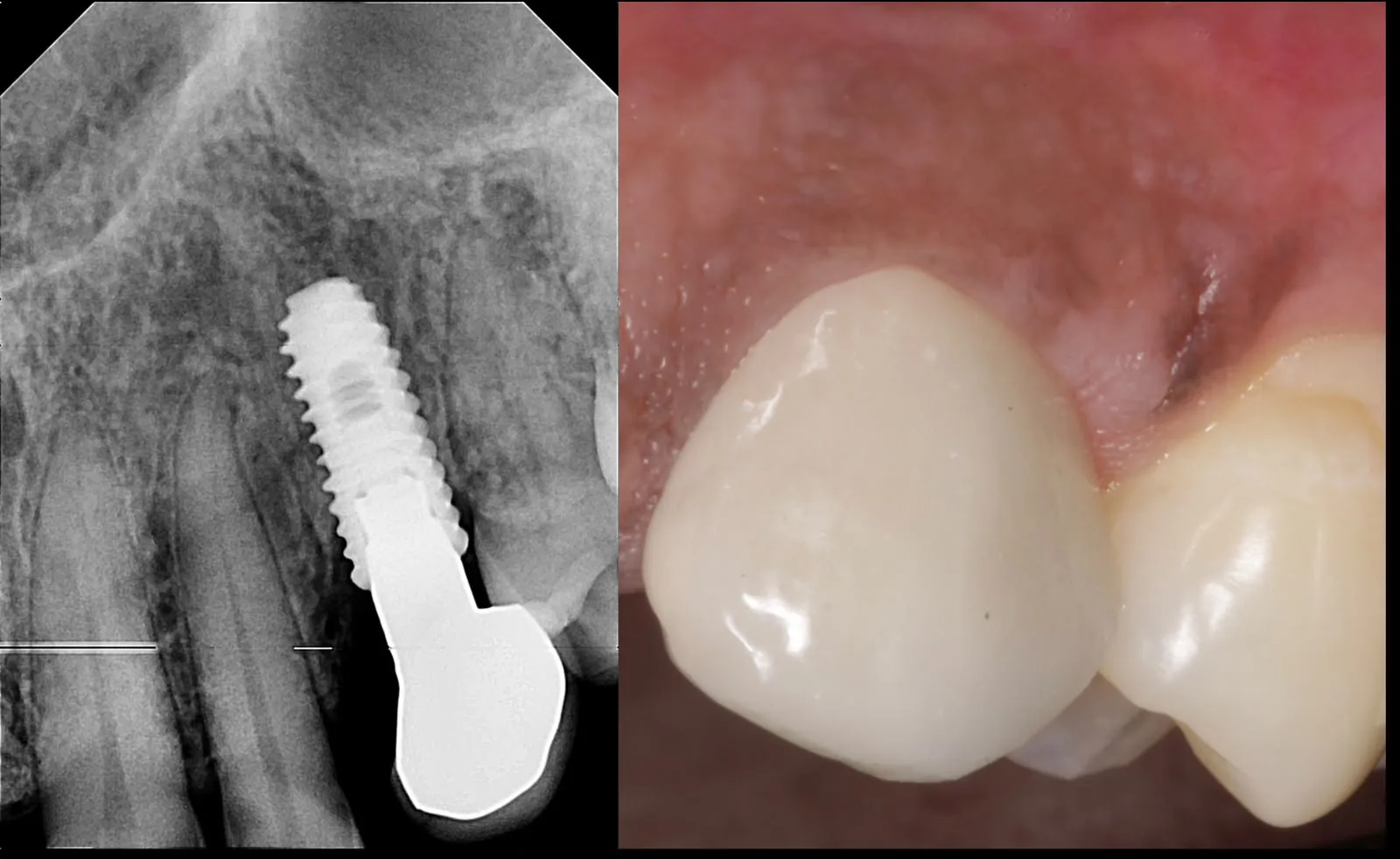
For more detail on the procedure, read our complete guide to dental implants in Vizag.
Will I have a temporary tooth during implant healing?
Often, yes, especially if the missing tooth shows when you smile. Depending on your mouth, this may be a small removable tooth, a temporary bridge or, in selected cases, a temporary crown attached to the implant.
A temporary crown cannot be attached to every newly placed implant. The implant must be stable enough, and the temporary tooth must avoid harmful pressure while healing takes place. For a back tooth that does not show, you may choose to leave the space temporarily. Ask before treatment which option suits you and whether its cost is included.
When a Bridge May Suit You
A bridge may be worth considering if the nearby teeth already need caps, you prefer to avoid implant surgery, or a shorter treatment time matters.
However, teeth with large fillings, existing caps or previous root canal treatment still need checking. Decay, cracks, weak gums or loose teeth can make them poor supports, and a later problem in one supporting tooth may affect the whole bridge. If a supporting tooth has had a root canal, read whether it needs a cap after root canal.
Dr. Konagala Ravi Kumar's MDS training in Conservative Dentistry & Endodontics focuses on saving and restoring natural teeth, which is directly relevant when assessing whether the teeth beside your gap can safely support a bridge.
How bridge treatment is performed
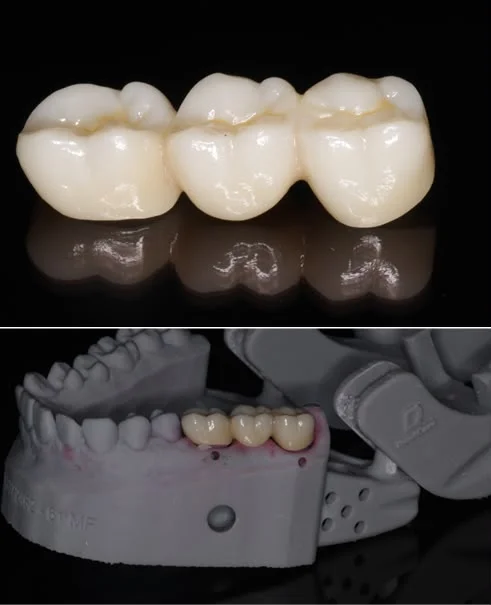
For a conventional bridge, the dentist shapes the supporting teeth and takes a mould or digital scan. A laboratory makes the joined replacement, which is checked on a model of your jaw (bottom photo) and then in your mouth before it is cemented in place. You may wear a temporary bridge between visits.
A bridge usually takes less time than an implant because there is no bone-healing stage. However, fillings, root canal treatment or gum care needed beforehand can add visits. Ask for a timetable based on your mouth.
Which Is More Painful: a Bridge or an Implant?
Both are done under local anaesthesia, so the procedure itself should not be painful. The difference is in recovery:
- Implant: some soreness, swelling or minor bleeding for a few days after the post is placed is common. Most people manage this with the painkillers their dentist advises.
- Bridge: no surgical wound, but the shaped supporting teeth can feel sensitive to hot or cold for a short while.
If worry about the procedure is holding you back, our tips for dental anxiety may help. Tell the team, so they can plan your visits around it.
Bridge vs Implant for a Front Tooth or a Back Tooth
Front tooth: appearance matters most. A bonded (Maryland) bridge may suit selected missing front teeth with little or no drilling, though it can come unstuck. An implant can give a natural result but needs enough bone and good gum contour, so planning is especially important here.
Back tooth: chewing forces are higher. The strength of the supporting teeth (for a bridge) or the bone volume (for an implant) usually decides the choice.
Why Would a Dentist Not Recommend an Implant or a Bridge?
A dentist may advise against an implant when there is not enough bone and grafting is not suitable, when gum disease is active, or when general health or habits (such as heavy smoking or uncontrolled diabetes) make healing less predictable.
A dentist may advise against a bridge when the neighbouring teeth are healthy and unrestored (so shaping them would cause avoidable damage), or when those teeth are too weak, loose or decayed to carry the extra load.
Other Questions About Bridges
Can I avoid cutting healthy teeth?
In selected cases, a bonded bridge attaches the new tooth using a small wing fixed behind a nearby tooth. It may need little or no drilling but can come unstuck. It may suit selected missing front teeth, depending on your bite and the supporting tooth.
Is root canal treatment compulsory before a bridge?
No. Healthy supporting teeth do not routinely need root canal treatment. Your dentist checks their nerves, roots and existing fillings. RCT may be needed if a tooth has irreversible nerve inflammation, a dead nerve or infection. Occasionally, a supporting tooth may need RCT after the bridge has been fitted.
Can a bridge be replaced with an implant later?
Yes, in many cases, but it needs careful assessment. Your dentist will reassess the bone, the available space and the previously prepared supporting teeth.
Implant vs Bridge vs Denture
A removable partial denture is a third option for one missing tooth. It is usually the lowest-cost and quickest, needs no surgery and little or no shaping of teeth, but it is less stable and must be taken out for cleaning. Learn more about dentures. If several or all teeth are missing, a single implant or bridge is no longer the comparison; ask about All-on-4 and All-on-6 implants.
Tooth Bridge vs Implant Cost in Vizag
An implant usually costs more at the start, but the total depends on the treatment you need. A starting price may exclude the connector, final crown, scans or extra procedures, so ask for an itemised estimate.
| Item | Typical range | What to check is included |
|---|---|---|
| Single tooth implant (implant + crown) | ₹30,000 – ₹60,000 | Implant post, abutment, final crown, CBCT, bone graft (if needed), temporary tooth |
| 3-unit bridge, metal-ceramic (PFM) | ₹15,000 – ₹24,000 | All three joined units, temporary bridge, treatment of supporting teeth |
| 3-unit bridge, zirconia | ₹24,000 – ₹45,000 | All three joined units, temporary bridge, treatment of supporting teeth |
| Bonded (Maryland) bridge | After examination | Wing retainer, pontic, bonding |
Compare the total cost of a finished tooth replacement. Do not compare the price of one cap with a complete bridge, or an implant post alone with an implant and crown. Over the long term, the costs can come closer than the starting price suggests, because a bridge may need replacing and its supporting teeth may need further treatment, but this varies from person to person. EMI and staged payment during treatment are available.
See our dental implants in Vizag and dental bridges in Vizag pages for more detail. Your dentist can give you a personal estimate after checking your mouth.
Not sure which suits your gap?
Send us your recent X-ray on WhatsApp, or call to book an examination at our MVP Colony clinic.
What to Expect After Treatment
After implant surgery, some soreness, swelling and slight bleeding can occur. Occasionally, an implant does not bond successfully with the bone. Later problems can include inflammation or bone loss around the implant, a loose screw or damage to the crown. Follow your dentist's care instructions and attend regular reviews; see how to care for dental implants.
Teeth supporting a bridge can develop decay or problems inside the tooth. Neither treatment is guaranteed to last forever. Both need daily cleaning and regular dental checks; ask the team to show you how to clean under your bridge or around your implant. Our team provides written aftercare instructions.
Contact your dentist promptly if pain or swelling increases, numbness continues, or the new tooth feels loose. For urgent problems, see emergency dental care in Vizag.
Frequently Asked Questions
Book a Consultation in MVP Colony, Vizag
If you live or work in Visakhapatnam, ask how treatment visits and healing time will fit your schedule, and explain your budget and any worries about surgery.
At Ravi's Dental Care & Implant Centre, Door No 1-56-20, Sector 2, MVP Colony, Visakhapatnam (opposite SBI Bank), our specialist team can examine the gap and explain whether an implant or a bridge suits you. Bring any old dental reports and a list of your medicines. We are open Monday to Sunday, 10 AM to 10 PM.
Summary
A dental implant replaces a missing tooth with a small post in the jawbone, while a bridge takes support from the nearby teeth. Implants usually avoid shaping neighbouring teeth but need minor surgery and months of healing. Bridges can often be completed in weeks. Ten-year survival is similar for both. The right choice depends on your teeth, gums, bone health, budget and preferences, confirmed by a dental examination.
References
- Pjetursson BE, Brägger U, Lang NP, Zwahlen M. Comparison of survival and complication rates of tooth-supported fixed dental prostheses (FDPs) and implant-supported FDPs and single crowns (SCs). Clinical Oral Implants Research. 2007;18 Suppl 3:97–113. PubMed
- Pjetursson BE, Thoma D, Jung R, Zwahlen M, Zembic A. A systematic review of the survival and complication rates of implant-supported fixed dental prostheses after a mean observation period of at least 5 years. Clinical Oral Implants Research. 2012;23 Suppl 6:22–38.

This article provides general patient education. Whether an implant or a bridge suits you can be confirmed only after a clinical and radiographic examination.