The short answer
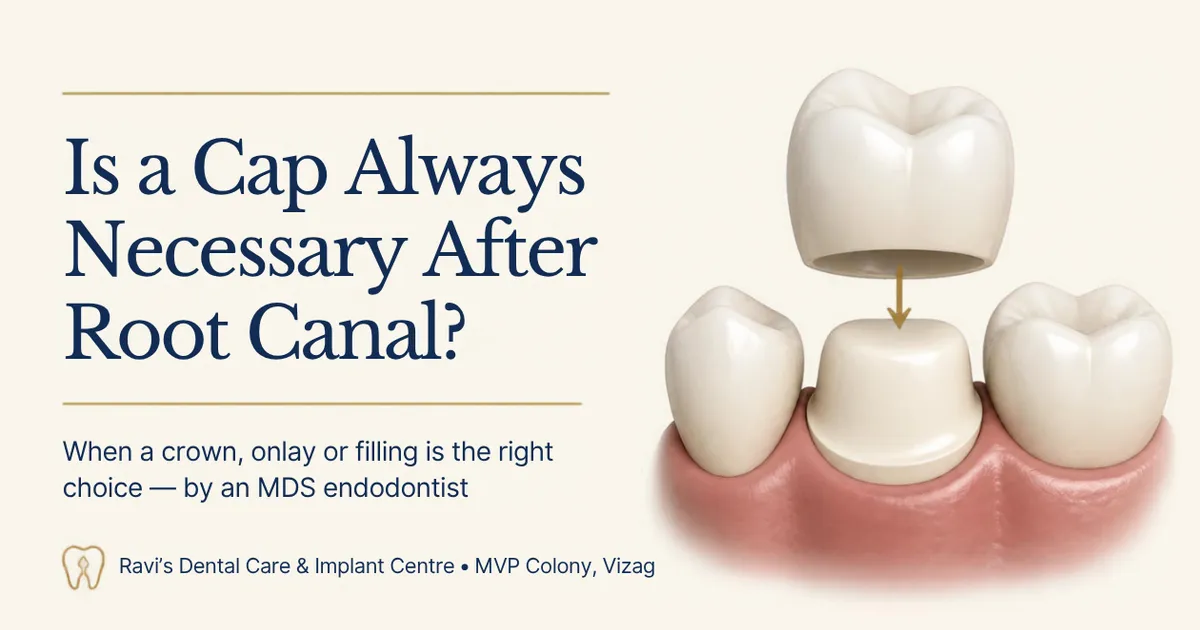
No, not always. Most back teeth that have had a root canal do need a cap (crown) or another form of cuspal protection. Some front teeth, and occasionally a premolar with very little structural loss, can be restored with a bonded filling or an onlay instead. What decides it is not the root canal itself, but how much healthy tooth is left afterwards, where the tooth sits, and how much chewing force it takes.
At Ravi's Dental Care in MVP Colony, every tooth that has completed root canal treatment in Vizag is assessed individually before the final restoration is chosen. This guide explains how that decision is made, how long a tooth can safely wait, what you can eat in the meantime, and what to expect when the cap is fitted.
Why a Root Canal-Treated Tooth May Need Extra Protection
A common belief, repeated on many clinic websites, is that a tooth becomes brittle because the nerve and blood supply are removed. That is an oversimplification. The American Association of Endodontists notes that the fracture risk of a root canal-treated tooth is mainly related to loss of tooth structure from decay, previous fillings, fractured cusps and the access opening made for the treatment, rather than to the tooth “drying out”.
Teeth that need a root canal usually already have deep decay, a large old filling or a crack. The treatment access removes a little more. So the real question after RCT is not “was a root canal done?” but “how much strong tooth is left?”
Front Teeth vs Back Teeth: Does the Cap Decision Change?
Yes, and this is the single biggest factor.
Front teeth (incisors and canines)
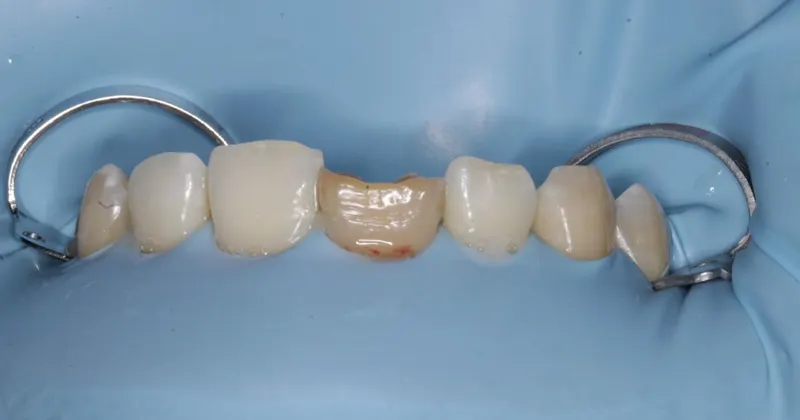
Front teeth bite and tear; they do not grind. If an incisor or canine has had only a small, conservative access opening, still has most of its natural structure, no crack and no large previous filling, a bonded tooth-coloured filling is often enough. A front-tooth root canal without a crown is therefore a legitimate, evidence-supported option in selected cases, not a shortcut. A cap becomes the better choice when the tooth is heavily filled, discoloured, fractured or has lost substantial structure.
Premolars and molars
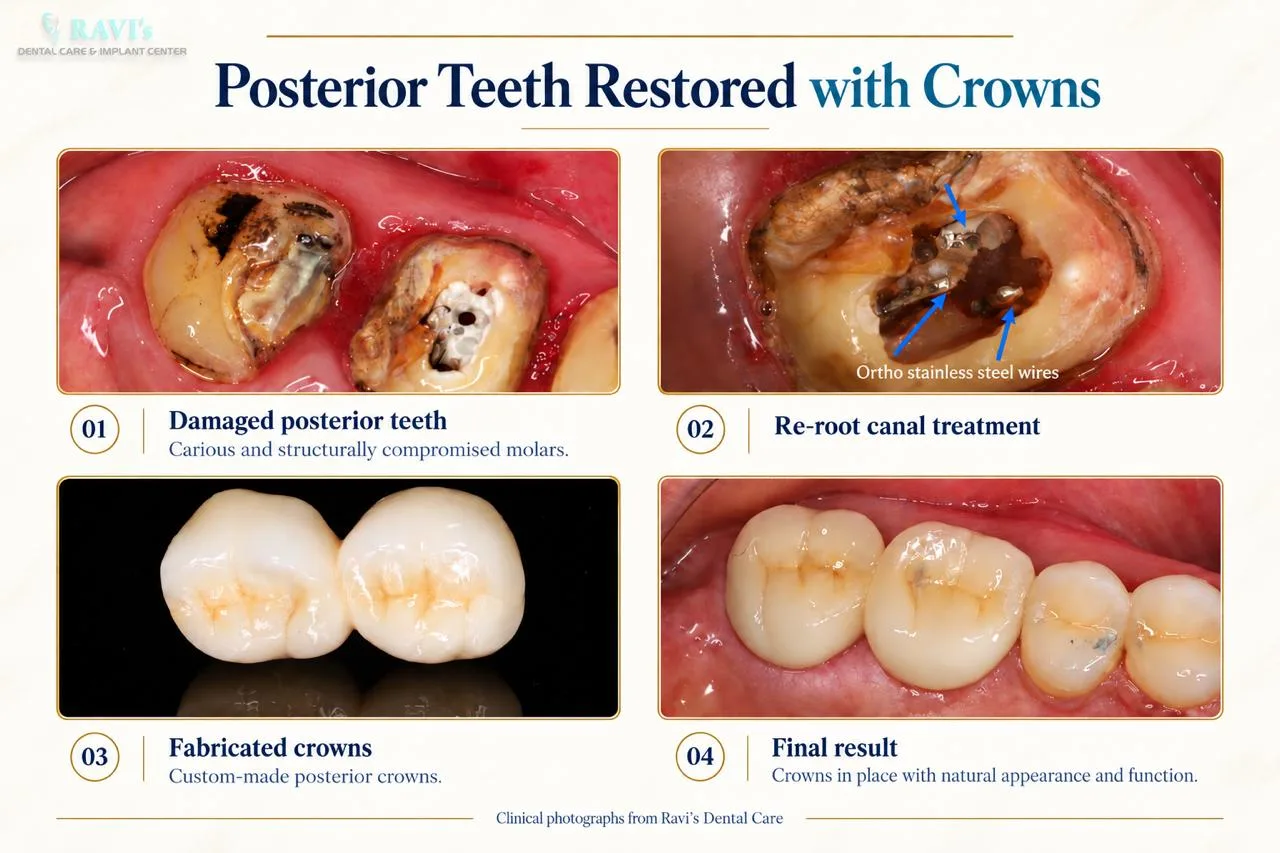
Back teeth take heavy vertical and sideways chewing loads. When a cusp has lost the tooth structure that supported it, it can flex and split under that load. For most root canal-treated premolars and molars some form of cuspal coverage is advisable. That does not always mean a conventional full cap: an onlay that covers the weak cusps while leaving the healthy walls untouched is often the more conservative choice.
How Much Tooth Structure Remains? The Three-Tooth Test
Imagine three root canal-treated teeth:
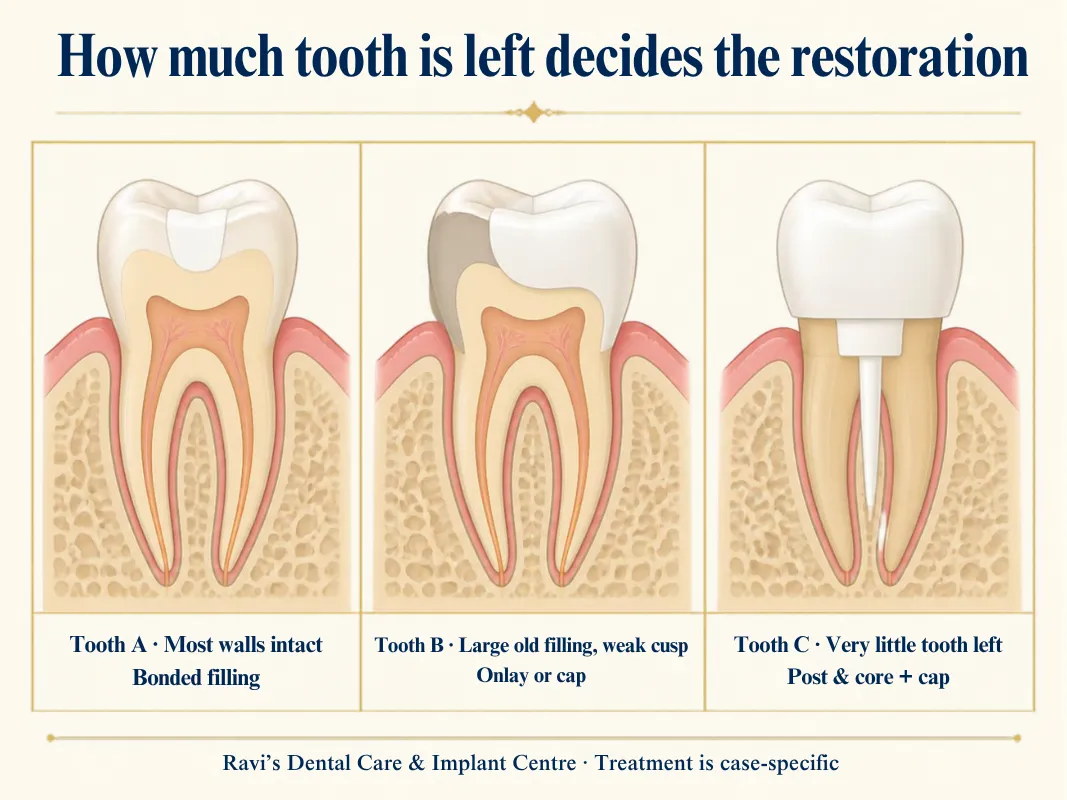
- Tooth A has almost all its natural walls and cusps intact. Only the small access opening needs filling.
- Tooth B has a large old filling and one or two weakened cusps.
- Tooth C has lost most of its structure, with only a small amount of sound tooth left above the gum.
These three teeth should not receive the same restoration. As structural loss increases, so does the need for protection: Tooth A may need only a bonded filling, Tooth B an onlay or a cap, and Tooth C a post-and-core build-up followed by a cap. The dentist checks the number of remaining walls, whether the marginal ridges are intact, cracks, cusp thickness, the bite, the tooth's position and whether the remaining structure can predictably hold the restoration.
Filling, Onlay or Cap After Root Canal?
Bonded filling. A tooth-coloured (composite) filling seals the access cavity and rebuilds missing internal structure. It suits teeth with minimal loss: mainly front teeth and the occasional premolar.
Onlay. An indirect, lab-made restoration that covers one or more weakened cusps while preserving the healthy tooth that does not need trimming. A conservative option for selected back teeth with enough sound structure left.
Cap (crown). Covers the whole tooth above the gum. It is the right choice when structural loss is major, several cusps are weak, the tooth carries a large old filling, or fracture risk is otherwise high. Which material to use (metal, metal-ceramic, zirconia or E-max) is a separate decision covered on our crowns page: which cap is best after root canal.
The European Society of Endodontology's position statement on restoring root canal-treated teeth recommends preserving sound tooth tissue and choosing the restoration for the individual tooth, rather than routinely preparing every treated tooth for a full crown.
What Does a Post Do, and Is It the Same as a Cap?
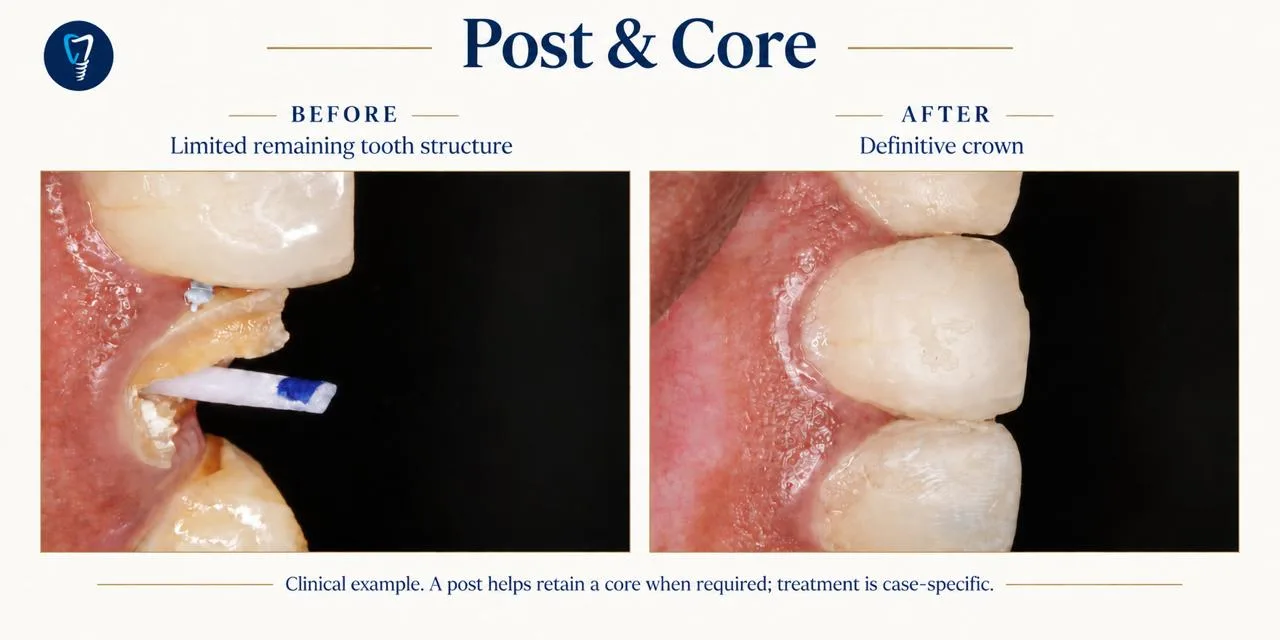
No. A post is a rod cemented part-way into a root canal. Its only job is to hold the core (the filling material that rebuilds the missing tooth) when there is not enough natural tooth left to retain it. A post does not strengthen a tooth, and it is not needed for every root canal-treated tooth. If enough structure remains to hold the core, a cap can be placed without a post; if most of the tooth is gone, a post-and-core build-up comes first and the cap sits on that.
How Long Can a Root Canal-Treated Tooth Last Without a Cap?
This is the question patients ask most, usually because they want to delay the cost. The honest answer: a front tooth with little structural loss and a good bonded filling can last for years without a cap. A back tooth that needs cuspal coverage but does not get it is a different matter. The risk is not that the root canal fails, but that the tooth splits.
A large US study of root canal-treated teeth found that those restored without a crown were lost at roughly six times the rate of those that received one over the follow-up period. A long-term UK study reported that teeth given a definitive cast restoration were markedly less likely to be extracted than those left in a temporary filling. A fracture that runs below the gum line usually means extraction, at which point the root canal you paid for is wasted.
It is safe only when a dentist has confirmed the tooth can be restored more conservatively. If cost is the reason for delaying, ask for staged payment rather than skipping the cap. Details of dental crowns in Vizag are on our service page.
After How Many Days of Root Canal Should the Cap Be Fixed?
Once the canals are permanently sealed, the definitive restoration should not be delayed unnecessarily. In practice most patients have the tooth prepared for the cap within one to two weeks of the final root canal appointment, and sometimes on the same day if the tooth is calm and the treatment was completed in a single sitting. The wait is a practical one, to confirm the tooth is comfortable on biting, not a healing rule; there is no evidence that a fixed two-week gap is required. If your treatment is being staged over more than one visit, the cap is planned after the last one; our guide to how many sittings root canal treatment takes explains why.
A temporary filling is not designed to seal the tooth for months. It wears, leaks and can allow bacteria back into the canals. If your temporary comes out, the tooth chips, or you develop swelling or severe pain, contact the clinic rather than waiting for the cap appointment.
What Can You Eat Before the Cap Is Fixed?
Until the tooth is fully restored, treat it as a tooth that is not yet at full strength:
- Chew on the opposite side where possible.
- Prefer soft and cooked foods: rice, dal, curd, idli, dosa, well-cooked vegetables, soft fruit, eggs, fish.
- Avoid hard, crunchy or sticky items on that side: nuts, murukku, hard chikki, ice, raw carrot, sugarcane, toffee.
- Keep the area clean: brush normally and floss carefully around the temporary.
Yes, you can eat after a root canal without a crown; you just cannot load the tooth as if it were fully restored. Once the cap is cemented and the numbness has worn off, normal diet resumes.
Is Cap Fitting After Root Canal Painful?
Usually not. Because the nerve has already been removed, shaping the tooth for the cap generally causes little or no sensation; local anaesthesia is used mainly for comfort around the gum. Some mild gum tenderness for a day or two after cementation is normal and settles on its own. The only common discomfort is a cap that feels “high” when you bite. That is a simple adjustment at the clinic, not a complication.
How Does the Dentist Decide What You Need?
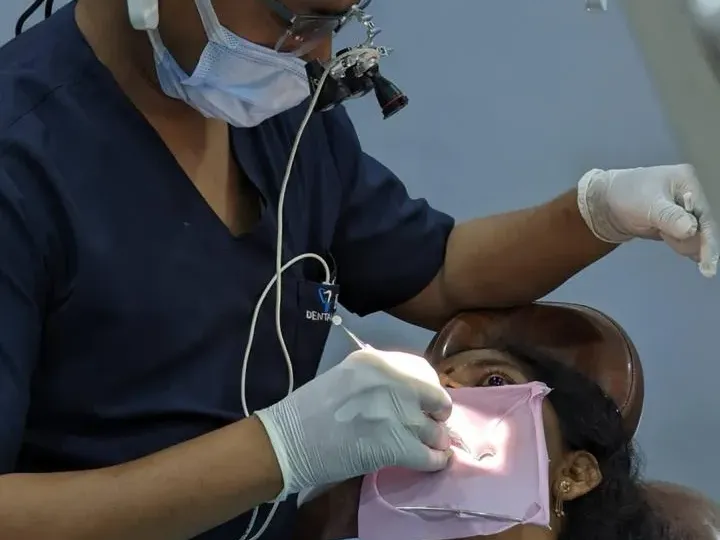
The choice between a filling, an onlay and a cap cannot be made from symptoms alone. A clinical examination is used to assess cracks, the remaining walls, cusp thickness and your bite; dental X-rays assess the roots, surrounding bone and previous treatment, but they do not show every structural weakness in the visible part of the tooth. Dr. Konagala Ravi Kumar, MDS, plans the final restoration around the amount of healthy tooth that can be preserved and the forces that tooth must withstand, and will tell you if a cap is not needed.
The Practical Answer
A cap after root canal treatment is not automatically necessary for every tooth. Some front teeth with minimal structural loss can be restored with a bonded filling; selected back teeth suit an onlay; most premolars and molars with substantial structural loss benefit from a cap or another form of cuspal coverage. The better question is: “What is the least invasive restoration that will adequately protect this particular tooth?”
If you have completed a root canal, here or elsewhere, and are unsure whether the cap being recommended is necessary, book an examination at Ravi's Dental Care & Implant Centre, MVP Colony, Visakhapatnam. You will be shown how much tooth structure remains and why a filling, onlay or cap is being advised. For pricing, see cap cost after root canal and root canal treatment cost in Vizag.
Told you need a cap and not sure why?
Send us your recent X-ray on WhatsApp, or call to book an examination with our endodontist in MVP Colony.
Frequently Asked Questions
Book an Examination in Vizag
Ravi's Dental Care & Implant Centre, Door No 1-56-20, Sector 2, MVP Colony, Visakhapatnam (opposite SBI Bank). Bring any recent X-rays if available. We are open Monday to Sunday, 10 AM to 10 PM.
References
- American Association of Endodontists. Guidance on the restoration of endodontically treated teeth.
- Mannocci F, et al. European Society of Endodontology position statement: the restoration of root filled teeth. International Endodontic Journal, 2021.
- Aquilino SA, Caplan DJ. Relationship between crown placement and the survival of endodontically treated teeth. Journal of Prosthetic Dentistry, 2002;87:256–263.
- Ng YL, Mann V, Gulabivala K. A prospective study of the factors affecting outcomes of non-surgical root canal treatment: part 2: tooth survival. International Endodontic Journal, 2011.

This article is general information and not a substitute for an examination. Whether a root canal-treated tooth needs a filling, an onlay or a cap can be confirmed only after clinical and radiographic examination of that tooth.