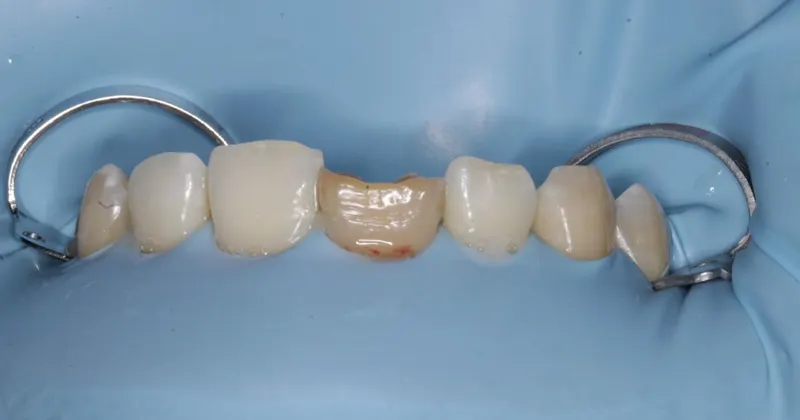
“How many sittings will it take?” is usually the second question a patient asks after being told they need a root canal. It is a fair question, and the honest answer is that the tooth decides, not the calendar.
The short answer
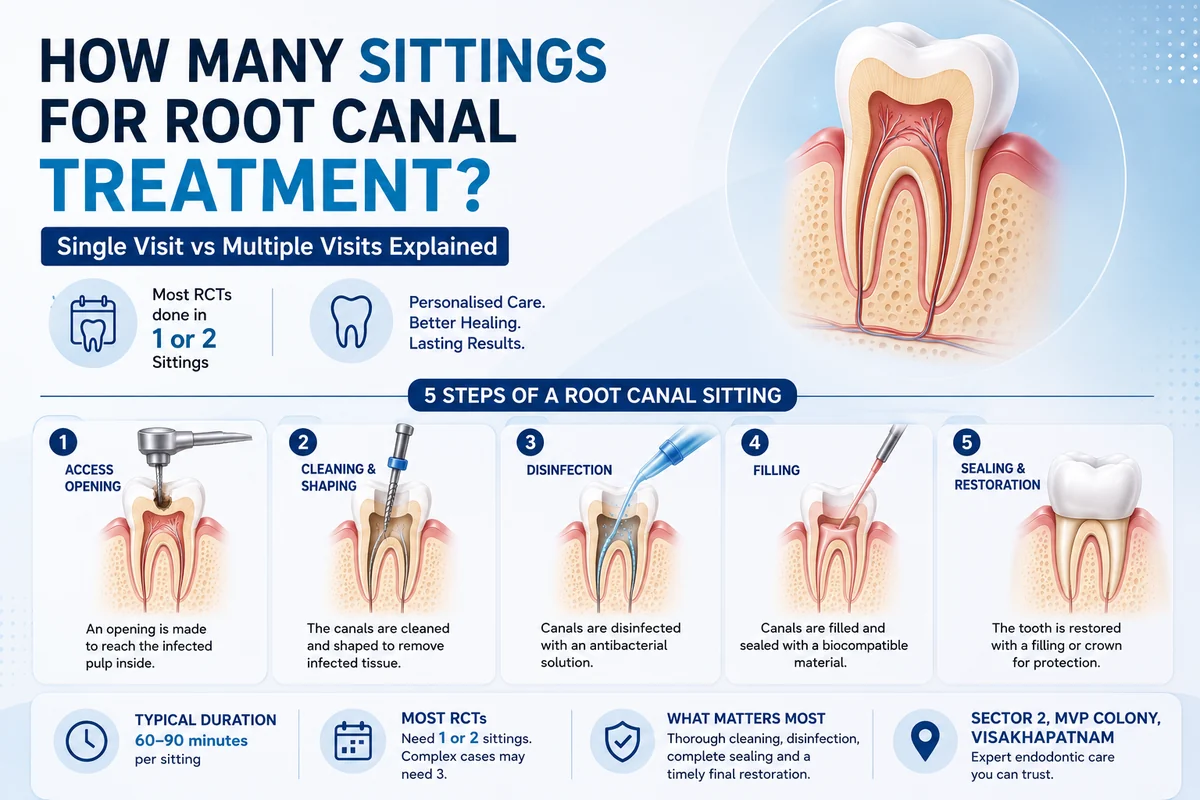
Most root canal treatments are completed in one or two sittings, while a complex tooth may need more. The number depends on the diagnosis, the complexity of the canal anatomy, active drainage or infection, any previous treatment, and whether the canals can be thoroughly cleaned, disinfected, dried and sealed safely that day.
A clinical examination and an X-ray, and occasionally a CBCT scan, are needed before your dentist can give you a reliable estimate.
Root Canal Sittings at a Glance
The table below shows how a tooth's condition usually maps to the number of appointments. Use it to set expectations, not as a quotation.
| Clinical situation | Likely RCT sittings |
|---|---|
| Straightforward, restorable tooth with canals that can be cleaned and dried | Often one |
| Persistent pus, fluid drainage or significant swelling | Often two or more |
| Curved, narrow or calcified canals | One or more, depending on how the canals negotiate |
| Previously treated tooth requiring re-RCT | Commonly multiple sittings |
| Core build-up or crown | Usually a separate restorative appointment |
These are general treatment plans, not fixed rules. Findings during treatment can change the planned number of visits.
What Is the Difference Between One-Visit and Multiple-Visit RCT?
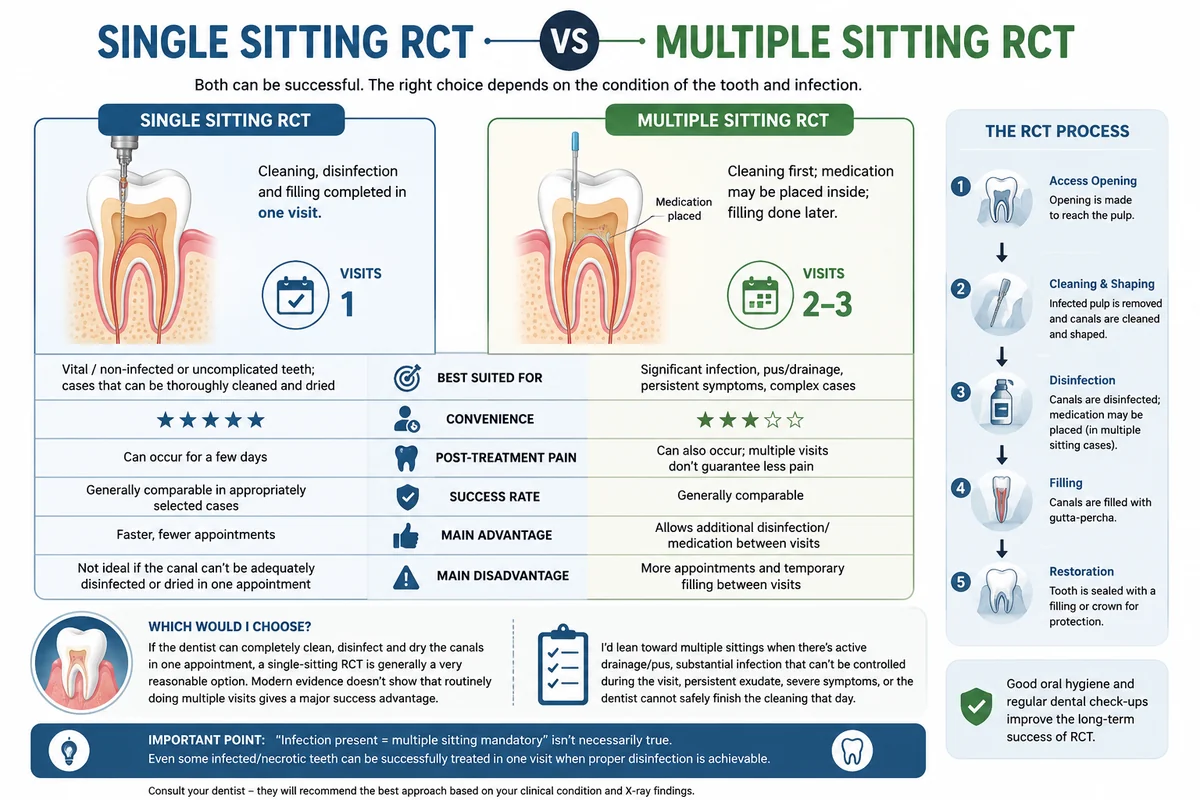
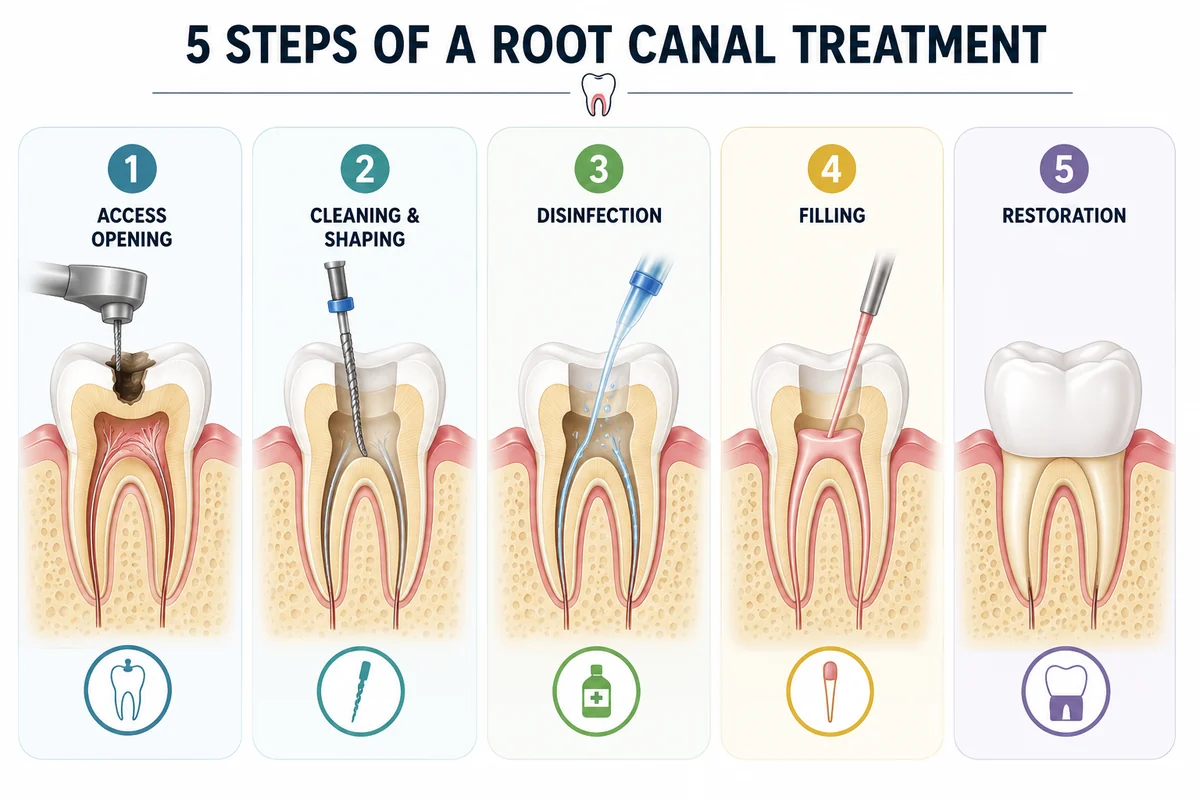
In a single-sitting root canal treatment, the dentist removes the inflamed or infected pulp, cleans and shapes the canals, disinfects them, and fills and seals them during one appointment.
In a multiple-sitting root canal, cleaning and disinfection begin during the first visit. When indicated, medicine is placed inside the canals and a temporary filling protects the tooth. At a later appointment the dentist reassesses the tooth and seals the canals once conditions are suitable.
The term “single-sitting RCT” refers only to the root canal procedure. A permanent filling, core build-up or crown may still require another appointment.
Is Single-Sitting or Multiple-Sitting Root Canal Treatment Better?
Neither approach is automatically better for every tooth. Good case selection, proper isolation, thorough disinfection, complete sealing and a timely final restoration matter far more than simply finishing quickly.
A 2022 Cochrane review found no clinically significant difference between single-visit and multiple-visit treatment when healing was assessed on X-rays after one year. The same review found that patients treated over multiple visits were probably less likely to experience pain during the first week, although short-term discomfort can occur with either method. Those results hold only when single-sitting root canals are completed with rubber dam isolation and a proper irrigation protocol.
The European Society of Endodontology guideline recommends a single-visit approach for selected permanent teeth with asymptomatic apical periodontitis, provided the clinical procedures can be completed adequately.
When Can a Root Canal Be Completed in One Sitting?
A one-visit RCT may be considered when:
- The tooth is restorable.
- The canals can be located and managed predictably.
- Rubber dam isolation and adequate disinfection can be maintained.
- The canals can be prepared, dried and sealed safely.
- There is no persistent pus or fluid preventing a sound seal.
- The patient can comfortably tolerate the required chair time.
Single-sitting treatment reduces travel and time away from work, which matters for busy patients in Vizag. Convenience should still follow the diagnosis and safe clinical progress, not the other way round. Our guide to painless root canal treatment in MVP Colony explains what a single sitting actually feels like from the chair.
Why Does a Root Canal Sometimes Require Two or More Sittings?
An endodontist may stage treatment for several reasons.
Persistent drainage
A canal that keeps releasing pus or fluid is not ready for final sealing. Sealing over active drainage risks trapping infection inside the tooth.
Acute swelling or abscess
Drainage and relief of pressure become the first priority. Comfort comes first; the definitive seal follows once the tooth settles.
Complex anatomy
Curved, narrow, calcified or unusually shaped canals need more time to negotiate, shape and disinfect properly.
Previous root canal treatment
Removing old filling material and locating missed anatomy makes re-root canal treatment more demanding than a first-time case.
Unexpected findings
An obstruction, limited mouth opening or a need for further imaging can justify stopping safely and continuing at the next visit.
Patient comfort
A long appointment can be divided when a patient cannot comfortably continue. There is no clinical benefit in pushing through.
An additional sitting is not a sign that something has gone wrong. It is often the safer way to complete treatment properly.
How Many Sittings Are Needed for Root Canal Treatment: What Decides?
Before treatment, the dentist evaluates:
- Pain and sensitivity symptoms
- Swelling, drainage and gum condition
- Pulp and biting-test findings
- Dental X-rays
- Remaining tooth structure and restorability
- Previous fillings, crowns or root canal treatment
During treatment, the endodontist assesses the number and shape of the canals, whether they can be prepared to the correct working length, and whether the canal system can be adequately dried before sealing. CBCT is generally reserved for selected complex cases, when examination and conventional dental X-rays do not provide enough information.
Dr. Konagala Ravi Kumar explains to patients at Ravi's Dental Care in MVP Colony that the initial estimate covers the expected number of appointments and a realistic timeline, without rushing the tooth. An unexpected clinical finding may appropriately add another sitting.
Does a Molar Always Need More Root Canal Sittings?
No. Molars commonly have more canals and may need a longer appointment, but many molar root canals are still performed in one visit.
A front tooth may need staged treatment because of trauma, persistent drainage, unusual anatomy or previous treatment. Tooth type affects complexity, but it does not determine the number of sittings by itself.
How Long Does Each Root Canal Sitting Take?
A root canal appointment commonly takes around 60 to 90 minutes, although the time varies with the tooth, the number of canals and the complexity of the anatomy. The American Association of Endodontists also notes that most root canal treatments can be performed in one or two appointments.
How Many Days Should There Be Between RCT Sittings?
There is no universal interval; it depends on the clinical situation of the tooth being treated. When intracanal medicine is placed, the next appointment is commonly planned after approximately 5 to 7 days, but the correct timing depends on the diagnosis, the symptoms and the material used.
Attend on the advised date even if your toothache has stopped. Pain relief does not mean the root canal treatment is complete.
Is the Crown Included in a Single-Sitting Root Canal?
Not automatically. After the canals are sealed, the tooth may still require a permanent filling, a core build-up or a crown.
Back teeth frequently need cuspal protection because they carry heavier chewing forces. Whether a front tooth needs a crown depends on the remaining tooth structure, the fracture risk and cosmetic requirements. You can learn more about dental crowns after root canal treatment. Whether the tooth then needs a cap is a separate decision — see is a cap necessary after root canal.
What Should You Do Between Root Canal Sittings?
If your treatment is being completed over multiple appointments:
- Brush and floss gently around the tooth.
- Avoid hard, sticky foods and chewing hard on that side.
- Do not miss the next appointment even if the pain has reduced.
- Contact the clinic if the temporary filling loosens or comes out.
- Call early if swelling or pain becomes worse, or the tooth cracks.
- Call the clinic if your mouth opening reduces between appointments.
Pain, Recovery and Warning Signs
Local anaesthesia is used when required. Mild tenderness while biting can occur for a few days, particularly when the tooth was painful before treatment. Many patients return to routine work the same day, but should wait until the numbness has completely worn off before chewing.
Seek prompt dental review if you develop:
- Facial or gum swelling
- Severe or increasing pain
- Fever or a feeling of being unwell
- A painful or uneven bite
- Loss of the temporary filling
Difficulty swallowing or breathing requires urgent medical assessment. If you are unsure whether your symptoms need same-day attention, our guide to toothache warning signs and our emergency dental care in Vizag page will help you judge.
Antibiotics do not replace root canal cleaning or drainage. The American Dental Association guideline recommends prioritising definitive dental treatment for most localised dental infections, and reserving antibiotics for selected cases such as systemic involvement or spreading infection.
Do More Root Canal Sittings Increase the Cost?
Not necessarily. Clinics commonly charge for the RCT as one procedure rather than by the number of appointments.
The total cost usually depends on the tooth, the canal complexity, whether it is a first treatment or a retreatment, imaging, the core build-up and the final restoration. Ask for a written estimate that separates the RCT fee from the crown. See our detailed root canal treatment cost in Vizag guide for current local pricing.
Not sure how many sittings your tooth needs?
Send us your X-ray on WhatsApp and our specialist team will give you a preliminary opinion, usually within 30 minutes.
Frequently Asked Questions
Need an Assessment for Root Canal Treatment in Vizag?
If you have persistent tooth pain, sensitivity, swelling or a tooth that has been advised for RCT, an examination can clarify the likely treatment timeline.
At Ravi's Dental Care & Implant Centre, Door No 1-56-20, Sector 2, MVP Colony, Visakhapatnam (opposite SBI Bank), Dr. Konagala Ravi Kumar, MDS endodontist, can examine the tooth and explain whether single-sitting or multiple-sitting root canal treatment in Vizag is appropriate for your condition. We are open Monday to Sunday, 10 AM to 10 PM.
Summary
Most root canal treatments require one or two sittings, although complex cases may need more. Single-sitting RCT is suitable when the canals can be completely cleaned, disinfected, dried and sealed safely. Persistent drainage, swelling, difficult canal anatomy or retreatment may require additional visits.
Neither approach is automatically better. The correct choice depends on the condition of your tooth, and the crown or permanent restoration may still need a separate appointment.
References
- Manfredi M, et al. Single versus multiple visits for endodontic treatment of permanent teeth. Cochrane Database of Systematic Reviews, 2022.
- Duncan HF, et al. Treatment of pulpal and apical disease: the European Society of Endodontology (ESE) S3-level clinical practice guideline. International Endodontic Journal, 2023.
- Lockhart PB, et al. Evidence-based clinical practice guideline on antibiotic use for the urgent management of pulpal- and periapical-related dental pain and intraoral swelling. Journal of the American Dental Association, 2019.
- American Association of Endodontists. Patient information on root canal treatment.

This article provides general patient education. The number of RCT appointments can be confirmed only after clinical and radiographic examination of the individual tooth.